Cost-effective content marketing in 2026: how to do more with less
drive traffic, generate leads, and boost brand awareness without breaking the bank. This guide breaks down 12 cost-effective strategies—from repurposing existing content to leveraging user-generated content—plus how AI can help you scale faster and cheaper.
BY Lydia Burns
July 16th 2026 – 8 min read
INSIGHTS
Cost-effective content marketing in 2026: how to do more with less
Content budgets are under more scrutiny than ever. Marketing teams are being asked to produce more content, reach more channels, and show faster ROI—all without proportional headcount or budget increases. The good news: the tools available in 2026 make it genuinely possible to do more with less...if you apply them strategically.
This guide covers what cost-effective content marketing actually means, why it matters more now than it did two or three years ago, and eight specific strategies your team can use today.
What is cost-effective content marketing?
Cost-effective content marketing is the practice of producing and distributing content that generates measurable business results, like leads, pipeline, brand awareness, organic traffic, at a lower cost per outcome than traditional approaches. It prioritizes strategic reuse, format efficiency, and channel focus over volume alone.
The goal isn't to spend as little as possible, but to extract the most value from every dollar and hour invested in content. Time is valuable, and the content you create should be, too.
Why cost-effective content marketing matters more in 2026
A few years ago, the barrier to content production was time and cost. Writing a blog post took hours. Building an infographic required a designer. That constraint naturally limited how much content any team could produce.
AI changed that equation completely. Today, anyone with access to a writing assistant can generate a 1,500-word article in minutes. The result is a content landscape flooded with mediocre, AI-generated text that readers have learned to skim past, and that search engines are increasingly downranking in favor of content with genuine expertise and distinctive format.
This creates both a problem and an opportunity. The problem: if your content strategy relies on volume as the primary lever, you are now competing with an essentially unlimited supply of low-cost output. The opportunity: teams that invest in quality, interactivity, and format differentiation stand out in ways that pure-text volume strategies never will.
The ROI gap in 2026 isn't in word count. It's in how well your content is structured to answer questions directly (for AI Overview and answer engine visibility), how engaging the format is (interactive content consistently outperforms static on time-on-page and conversion), and how efficiently your team can produce that quality at scale.
That's the case for cost-effective content marketing in 2026: not doing it cheaply, but doing it smart.
8 cost-effective content marketing strategies
Alright, here’s the million-dollar question: how do you keep content market strategy at a reasonable price? If you follow our advice, you’ll be at the top (and with more money in your wallet) in no time.
Here’s a preview:
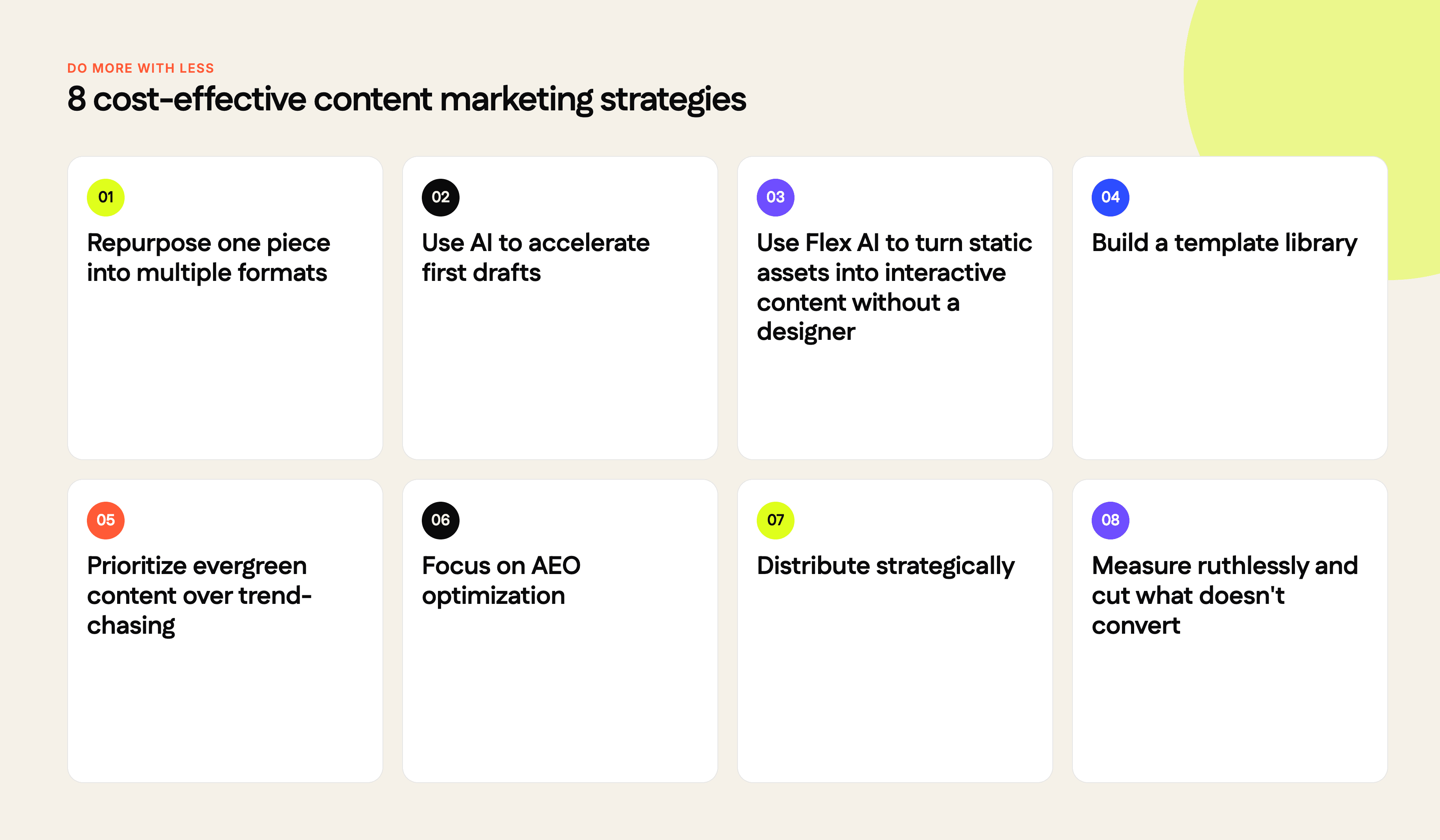
Let’s talk about each of these strategies in more detail so you have a better idea of what to do.
1. Repurpose one piece into multiple formats
The single highest-leverage move in content marketing is creating one strong, research-backed piece and extracting maximum value from it across formats. A white paper becomes an infographic. The infographic becomes a social carousel. The key findings become a short interactive assessment. The data points become a LinkedIn post series.
This isn't laziness, it's efficiency. Each format reaches a different audience segment and a different stage in the buying journey, all from a single investment in the underlying research and ideas. Before you commission new content, ask whether you have an existing asset that could be repurposed first.
2. Use AI to accelerate first drafts
AI writing tools — Claude, Jasper, and others — can reduce first-draft writing time by 60% or more when used well. The key phrase is "used well." AI-generated copy that ships without substantive human editing produces exactly the kind of generic content that's flooding the web in 2026.
The effective workflow is: use AI to generate structure, pull together research, and draft sections quickly, then apply genuine subject-matter expertise in the editing pass. You cut the mechanical parts of writing while preserving the human judgment that makes content trustworthy and distinctive.
3. Use Flex AI to turn static assets into interactive content without a designer
One of the largest cost centers in content marketing has historically been design. Interactive content — quizzes, assessments, scrollytelling pieces, animated infographics — required a designer and often a developer. That meant interactive formats were reserved for flagship campaigns, not regular production.
Ceros changes that constraint. Flex AI can take a static PDF — a white paper, a one-pager, a report — and convert it into a fully interactive experience. It can generate interactive content from a prompt, and it suggests design improvements as you build. A content marketer with no design background can produce interactive work that previously required an agency retainer.
For budget-constrained teams, this is significant: interactive content generates higher engagement and conversion rates than static equivalents, and Flex AI puts that format within reach without adding headcount.
4. Build a template library
The most expensive content is the content you have to design from scratch every time. Templates eliminate that cost. Build a library of approved layouts for blog posts, landing pages, email newsletters, social assets, and interactive experiences — then reuse them consistently.
A template library also enforces brand consistency without requiring a design review on every piece. Once the template is approved, the production team can work independently. The upfront investment in building solid templates pays dividends on every single piece that follows.
5. Prioritize evergreen content over trend-chasing
Trend content generates a spike and then goes flat. Evergreen content, things like guides, how-tos, comparisons, and foundational explainers, generates compounding returns as it accumulates backlinks and organic traffic over months and years.
For teams with limited resources, the math strongly favors evergreen. A well-executed evergreen piece can drive consistent traffic for two or three years with a single update pass annually. A trend piece requires constant replacement. Audit your content calendar and ask what percentage of planned pieces will still be generating value in 18 months. If the answer is low, rebalance toward evergreen.
6. Focus on AEO optimization
Answer Engine Optimization (AEO) is the practice of structuring content to be cited via AI-generated answers in Google AI Overviews, ChatGPT, Perplexity, and similar systems. Being cited in an AI answer provides reach that extends beyond traditional search rankings, because it puts your content in front of users who never click through to a results page.
AEO-optimized content is structured around direct, clear answers to specific questions. It uses short definition blocks, numbered steps, and FAQ sections. It cites sources. It's written to be extracted and quoted, not just read. Layering AEO structure into your existing content is relatively low-cost and compounds over time as AI-assisted search becomes the dominant discovery channel.
7. Distribute strategically
Distribution is where most content budgets leak. Teams produce good content and then rely on their own channels to distribute it. For teams that haven't built large audiences, this limits reach dramatically.
Strategic syndication means placing content on platforms with built-in audiences: industry publications, partner newsletters, LinkedIn articles, Medium, and content aggregators relevant to your vertical. Not every piece should be syndicated everywhere. Instead, focus on the highest-performing evergreen pieces and put syndication effort there. One well-placed syndication deal can generate more qualified traffic than months of organic social posting.
8. Measure ruthlessly and cut what does not convert
The fastest way to reduce content costs is to stop producing content that does not work. Most content calendars contain a significant percentage of formats, topics, or channels that consume budget without generating meaningful results.
Build a simple measurement framework: traffic, engagement (time on page, scroll depth), and conversion (email sign-ups, form fills, demo requests). Review it quarterly. Cut or restructure the bottom quartile. Double down on what is working.
***
A new trend emerged a few years ago, one that changed how we work so drastically that it feels like we can’t live without it anymore. Yep, we’re talking about artificial intelligence.
But the question is: can you use it for content marketing?
Let’s find out!
How can AI lower the cost of content marketing?
AI is truly helpful in keeping your content marketing within budget, due to its ability to optimize your processes. As a result, you’ll achieve greater efficiency, better resource management, and more targeted strategies.
But how?
For instance, many AI tools create content at scale, from simple articles to social media posts. It’s less costly than hiring a writer and decreases the time it takes to create the content (it’s done in minutes rather than days).
Don’t get us wrong — we’re not gonna paint artificial intelligence as this one great thing that solves all your problems (although it’s close). It does have its pitfalls, such as:
❌ Legal and ethical concerns — People are concerned that you, or rather AI, will steal their data. Which is a fair concern since AI uses sensitive information (without asking for permission) when collecting data.
Plus, AI is biased. According to USC researchers, 38.6% of ‘facts’ used by AI aren’t fair to all genders, races, and locations. Yikes. 😬
❌ AI is inaccurate — Oh, you’ve surely seen plenty of AI disasters. Like when Microsoft deleted an AI-generated article that recommended tourists visit the Ottawa Food Bank.
So, when you use AI tools, make sure to check the text for accuracy and any fairy-tale answers that will harm your reputation.
❌ AI lacks emotion and creativity — AI is great at taking information from the Internet and generating text. But you may well find it lacking in the emotional department. As a result, your text might sound robotic and lacking in personality.
Moreover, AI won’t be able to come up with original content; it’ll just rephrase content already publicly available.
Okay, we’ve talked enough about negative stuff. Let’s focus on the positive side of AI and see how it can help lower the costs of content marketing.
Keyword research
SEO is highly important for every content marketing campaign. Without it, search engines won’t even consider your content, so you won’t rank highly with them.
In specialized fields like SaaS content marketing, for example, that’s a big no-no, as you might miss out on opportunities to sell your product.
To help you (and save you time and coffee wasted during research) AI can generate keywords based on your business, product, or service.
There are plenty of tools that perform personalized and in-depth keyword research and come up with content ideas based on those keywords.
Brainstorming content ideas
Oh, is this you when you’re out of fresh ideas?
We feel you. ✋But after discovering AI, things got a lot easier. With just a simple prompt, AI can generate ideas for your next article, social media posts, and more.
Oh, is that a segue I smell? Yep! The tool you need to create content at scale and brainstorm is Ceros. With Studio, you can craft interactive designs that stand out and drive sales. Plus, Ceros offers 150+ preloaded templates to kickstart your creative process—making it all feel effortless!
Drafting content
With artificial intelligence, you can empower your writers to focus on what they do best! AI tools can help produce content — of all kinds — more efficiently and quickly, enhancing your creative process.
Okay, maybe not entirely better. You still need someone to tweak it and give the text life and a voice. It’s the only way to make your content stand out and nurture your relationship with your customers.
But AI does give you a hand when you need it the most.
Streamlining and scaling content creation
There’s only one true way to streamline the content marketing process and create content at scale: Ceros.
With Editor, it’s super easy to edit copy, images, and interactions so you can post content faster. But Editor also helps with content scaling, which means you’ll produce more quality content pieces at a faster rate.
The best part?
You don’t need specialized knowledge to use Editor. Its interface is intuitive and simple, so you can start creating the interactive content you want right away.
Ceros will never let you down; whenever your business grows, Ceros will be there for you, every step of the way.
***
One more thing and then you can start creating your own budget-friendly content marketing strategy.
Let’s talk about how to measure your campaigns’ success.
How to measure the cost-effectiveness of your content marketing campaign
Luckily, you don’t have to use measuring tape for this task.
But you should take the time to measure the cost-effectiveness of your content marketing campaigns through a few important metrics. Here’s a list:
Conversion rate– This metric measures the percentage of visitors who complete the desired action of the campaign, like signing up for a newsletter, making a purchase, or downloading a resource.
Tracking conversions indicates how effective your content is when it comes to reaching your business objectives.
Engagement metrics– How well does your content resonate with your audience? You don’t know? Well, you must. This metric tracks likes, shares, and comments — anything your audience does. The higher the rate, the better, as it shows your content is relevant and valuable to your customers.
Email engagement– If you’re an avid fan of email marketing, then you’ll definitely want to measure how much your clients interact with your email content. Think open and click rates, which indicate how likely your audience is to buy from you.
Cost per Lead (CPL)– To truly understand how cost-effective is your content marketing campaign, you need to measure CPL. It shows you how much it costs to generate a lead through your content and if your efforts are yielding a good return on investment.
Website traffic– Organic search? Social media? Referrals? Where does your traffic come from? Understanding this can help you figure out which channel is most effective in driving traffic. You can then allocate resources more efficiently and focus on the channels that yield the best results.
Bounce rate– This is a metric you don’t want to be high because it indicates that your content isn’t meeting user expectations and isn’t relevant to your audience.
What can you do to reduce bounce rates? Make content as relevant as possible, but don’t forget about its quality. If you do this, you’ll surely raise your engagement and conversion rates.
You’re now set to tackle this wonderful world of cost-effective content marketing. Godspeed!
Start producing more with less
The shift toward AI-assisted content production is real, and it's compressing the cost of mediocre content to near zero. That is a threat if your strategy relies on volume. It's an opportunity if you focus on quality, format differentiation, and strategic distribution.
Ceros is built for exactly this moment: it gives content teams the ability to produce interactive, visually differentiated content without design or development resources. Flex AI takes the barrier even lower, turning static assets into interactive experiences from a prompt.
If you're rebuilding your content stack, start with the strategies in this guide and evaluate which tools can remove the biggest bottlenecks in your current workflow.