Content marketing for publishers in 2026: strategies and examples

Publishers, we see you. 😅
You’re juggling a TON — from pumping out quality books, magazines, newspapers, and journals to making sure every detail is perfect. All while your coffee intake could probably rival a small café’s supply.
But don’t sweat it! We’ve got the secret key to help you navigate these challenges and turn your publishing expertise into something modern, interactive, and totally valuable.
In this article, we’re diving into why content marketing matters for publishers and how to build a strategy that actually works for you.
BY Mary Mattingly
July 9th 2026 – 7 min read
INSIGHTS


Content marketing for publishers: What you need to know in 2024
The publishing industry has always sold two things: audiences and content. Content marketing is where those two products converge. But in 2026, the rules of that convergence have changed. AI-generated search summaries are intercepting organic traffic before readers ever reach a publisher's site. Brand partners are raising their standards for sponsored content, demanding differentiated, interactive experiences that justify premium investment. And publishers competing on static editorial alone are losing ground on both fronts.
This guide covers what content marketing actually means for publishers in 2026, why the old playbook is no longer enough, and the specific strategies — from sponsored interactive microsites to AEO content optimization — that are generating real results for media brands today.
What is content marketing for publishers?
Content marketing for publishers is the practice of creating and distributing content that serves two simultaneous goals: attracting and retaining audiences, and building commercial value for brand partners and advertisers. Unlike traditional display advertising, publisher content marketing integrates brand messaging into editorial formats — data features, interactive reports, and microsites — that readers actively choose to engage with. Publishers use content marketing both to grow loyal readership and to offer sponsors premium, high-engagement placements that command stronger CPMs than standard ad inventory.
Why publishers need to evolve their content strategy in 2026
Three forces are reshaping what effective publisher content marketing looks like this year.
AI overviews are compressing organic search traffic. Search engines now surface AI-generated summaries at the top of results pages, answering common queries without sending users to the underlying source. Publishers who rely on search-optimized editorial content as their primary traffic driver are seeing click-through rates fall for informational queries. The solution isn't to abandon SEO — it's to produce content that AI summaries can't replicate: proprietary data, original research, interactive visualizations, and expert perspectives that require the full page experience to deliver their value.
Advertisers are paying premium CPMs for branded interactive experiences. As programmatic display rates flatten, publishers are finding that sponsored interactive content — branded microsites, interactive data features, custom digital supplements — commands significantly higher rates per impression. Brands want to associate with editorial quality, and they are willing to pay for it when publishers can demonstrate engagement depth beyond a page view.
Audience loyalty is increasingly tied to experience quality. Readers who find a publisher's interactive features, data tools, and original formats genuinely useful return more often and subscribe at higher rates. Static article pages, however well-written, don't create the same stickiness. Publishers investing in interactive content formats are building audience habits that are far harder for competitors or AI-generated content aggregators to disrupt.
What are the key components of a content marketing strategy for publishers?
Any good thing in life is made out of something. Your phone is made out of nuts and bolts and chips. A burger has the patty, the meat, and some salad in between the buns.
So why would a content marketing strategy for publishers be any different?
It’s not. It has all the ingredients to make it perfect; sneak a peek at our nice graphic to get a glimpse at the recipe:
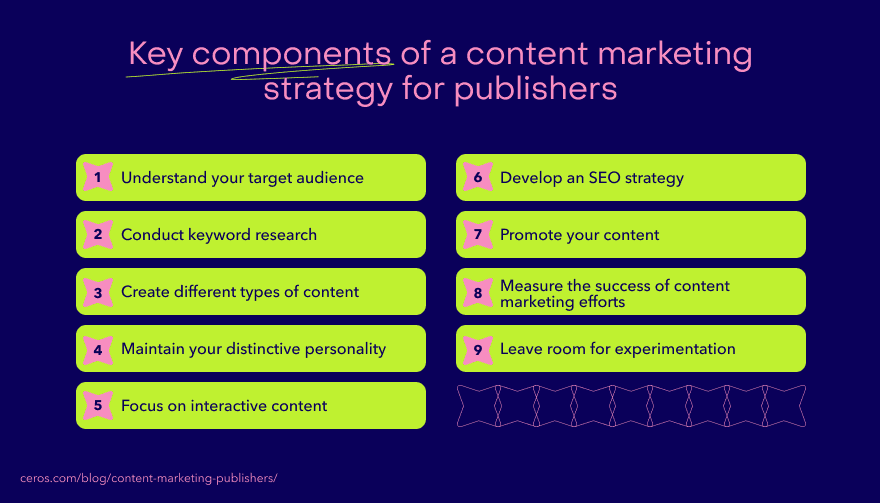
Now, let’s go through all these ingredients and see what they’re about.
1. Understand your target audience
The product is not about you, it’s about them. Whoever ‘them’ are. Knowing your audience is a crucial step in any content marketing strategy since you need to understand who they are, what they want, and how you can fix their problems.
When you put your clients first (and don’t create products and services you think someone would like) you’ll cater to their needs and preferences, and they’ll be more compelled to interact with your brand.
So, remember: create content for a niche audience to attract them!
2. Conduct keyword research
We know. But you know what’s even harder? Driving organic traffic without doing your keyword research. Why? Optimizing your content for search engines is a surefire way to rank higher when people search using a term or phrase you qualify for. As a result, they’ll easily find your content.
In a nutshell, search engines index your content to improve discoverability, which attracts more organic traffic. By displaying your content higher on the search results, it fulfills your users’ search intent better.
3. Create different types of content
Blog posts: Probably the most common type of content used in marketing, blog posts can generate leads and excitement around various subjects. Publishers can turn their output into easily digestible articles that drive massive organic traffic and improve their content’s reach.
Infographics: As a publisher, you can use infographics to display your content in a fun and simple way. Have a column in your newspaper with tips on how to eat more healthily? Turn it into a neat infographic for your online audience — they’ll love it!
Social media content: Oh, social media, what would we do without you? Love it or hate it, it’s undeniable that social media is the place to be, especially if you’re a publisher. You have millions of ways to build brand awareness, grow a huge follower base, and generate leads by publishing informative and high-quality content.
Emails: Here’s a thing publishers will definitely love. Email campaigns are great tools for nurturing leads, driving traffic to your content, and keeping subscribers in the loop with what’s new in your company. It’s a proven way to grow your audience base and encourage readers to interact with your content.
Publishers can use Ceros to create highly engaging and effective content of all kinds. E-books, presentations, infographics, blog posts — your wish is our command.
4. Maintain your distinctive personality
The grass isn’t always greener on the other side. You might think that being like your rival (professional, but cheerful at the same time) is the key to your audience’s heart. But that’s not your style. You’re more of a joking, memeish kinda publisher.
And that’s totally okay, as long as it resonates with your audience and you do it with gusto.
The important thing is to maintain your distinctive personality and be you. Sure, focus on your audience and what they want, but don’t lose your sense of self. You need to show off that brilliant, passionate, or snarky personality because it’s the only way to differentiate yourself from the crowd.
5. Focus on interactive content
Have you heard of interactive content before? No? Class is in session — let’s teach you a bit about interactive marketing and how it can turn casual users into active and loyal customers.
Why is interactive content better than the more traditional type? Mostly due to its immersive nature. Instead of simply sifting through content that leaves no real impression, users get to interact with the content.
For example, customers can participate in quizzes that reward them for their participation. Isn’t that more fun than just reading a huge chunk of text?
Of course, it is! Publishers can engage web visitors for longer, increasing brand awareness and building a stronger connection with their audience.
If you want to look at some amazing examples, check out Ceros’s Inspire gallery. You’ll surely find something you adore. 😉
6. Develop an SEO strategy
You don’t want your visitors to spend a lot of time searching for your content.
You want potential customers to find your content fast — that’s exactly why every publisher needs SEO. It optimizes your content so it ranks higher on SERPs, ensuring that people will always find your content.
SEO is the way to go if you want a cost-effective content marketing strategy, especially in the long term. As long as you rank high on SERPs, you’ll slowly increase your website traffic flow every day, which helps you organically generate more leads.
7. Promote your content
As a publisher, you know your stuff about promotion. And guess what? You’ll have to do it all over again, only digitally and through other means.
For instance, there’s influencer collaboration, which is a highly effective way to promote your content. What it entails is that you ask influencers from the field to talk about your product, which makes your brand more relatable and genuine.
You can also try to repurpose your content. Let’s say you’ve only created blog posts till now. But you can turn a blog post into a neat infographic. Or if you did a webinar on ten ways to get healthy, you can repurpose the webinar into a blog post.
There are millions of combinations — you just have to be strategic about it and find the type of content that works best for you.
8. Measure the success of content marketing efforts
One important thing you have to do is measure the success of your content marketing efforts. There are a few metrics you should keep in mind when doing so, such as:
Website traffic — Duh! It’s the best way to see how effective your content is because it tracks the number of visitors who frequent your pages. If there’s increased traffic, it indicates that your content works well at promoting your business and driving engagement.
Engagement metrics — How much time do people spend on your site? How many leave? Knowing these things is important in determining if your content is engaging enough for your readers. Increased engagement suggests your content is relevant and of high quality — so keep it up!
Social media metrics — Another important metric you should monitor is interaction on various social media channels — likes, shares, comments, and follower growth. It shows that your content resonates with your audience and that it’s able to spark conversations around a topic.
Conversion rates — What this means is how well your content drives the desired action. For example, if your goal is to get more newsletter sign-ups, conversion rates will show how many people perform that action.
SEO performance — SEO is important! Remember that, as it’s a good way of ranking organically with search engines. By tracking this metric, you’ll see where you rank, what your keyword performance is, and if your content drives organic traffic.
Audience retention — In a nutshell, this metric indicates your client's ability to maintain reader interest over time. If people keep returning to your website, then take that as a good sign!
Psst! You should know that Ceros has analytics capabilities. Which means it can help you — a publisher — track the effectiveness of your content more easily. Try it out!
9. Leave room for experimentation
Our last advice is: be creative! There’s no right or wrong way to do content marketing. If your thing is to do webinars every week, you can do that! If you like to show off your office and how much fun your company is, do that.
No one is stopping you. You should still pay attention to data, of course. But a gut feeling is just as important as data. What you need to do is experiment with different strategies and to not be afraid of mistakes.
After some trial and error, you’ll reach that sweet spot that brings in a loyal following.
***
One last thing —
Over to you!
Publishers! Are you ready?!
“For what?” you might ask, a bit confused. Well, to start creating the content you need to reach a broader audience and drive the traffic you want.
The only tool you need for this task is Ceros. You’ve already heard about what it can do, but if you want to see it for yourself, try it free today.