Content marketing for consulting firms: Complete guide [2026]

From thought leadership articles to interactive quizzes, there are ten proven content types that work for consulting firms. Here's how to pick the right ones, create them consistently, and measure what actually moves the needle.
BY Lydia Burns
July 17th 2026 – 8 minute read
GUIDES & TOOLS
Content marketing for consulting firms: Complete guide [2026]
Running a consulting firm and looking for an advertising system that…
Keeps bringing in clients long after it’s launched.
Promises even more clients.
Attracts clients who refer others.
…Can seem like an impossible task.
Well, that’s what content marketing is all about!
Curious?
Scroll down to learn more about this approach.
What is content marketing?
Content marketing is a marketing approach that involves creating and publishing helpful content related to your consulting services, to capture people’s attention.
You produce content that gets them to:
Know you
Trust you
And do business with you
One content marketer on Reddit defined it this way:
“It is a way to establish trust and a relationship with potential customers. …a means of educating people about a problem which they did not know they have.
Simply [be] helpful with your content and give away as much of your trade secrets for free as possible. [Tell] the story of your company, why you got into business other than making money. Explain how your product or service can add value without being too pushy.”
So as someone who’s in the business of helping people, why do you need content marketing?
Continue reading to find out.
Why is content marketing important for consulting firms?
According to the Content Marketing Institute, marketing today is impossible without great content.
And here’s the story behind that…
Let's say you create content that showcases your expertise (e.g. how small businesses can scale their business like a Fortune 500 company) and share it with your target audience. It shows them you're knowledgeable and the right firm to solve their challenges. Before you know it, they begin to trust you.
Once they do, you've hit the jackpot because they're likely on the quick path to becoming buyers.
That trust is crucial to your firm's success, as Michiel Schipperus, former CEO of Sana Commerce, puts it: "Trust is an essential factor in purchasing decisions […] suppliers need to set themselves apart from competitors to win customer trust and business."
Plus, a survey of over 1.2k B2B buyers shows people are more likely to buy from brands they trust.
Here's what's new in 2026: prospective clients are now running queries through ChatGPT, Perplexity, and similar tools before they ever visit your website or pick up the phone. These tools surface firms, reports, and insights that are already cited across the web. If your firm isn't publishing content authoritative enough to earn those citations, you're invisible at the exact moment a client is forming their shortlist — no amount of trust-building matters if you never make the list in the first place.
The fix looks a lot like good SEO always has, just with a sharper premium on specificity and sourcing: publish proprietary data, name your methodology, and attribute your thinking to real people at your firm. Generic content gets ignored, by humans and AI systems alike.
But what does content marketing actually mean for you, day to day? Peep the next section.
What are the benefits of content marketing for consultants?
Now, let's explain in clear terms what content marketing gets you as a consultant:
Increased reach:
After you create content, you'll publish it on a hub that almost everyone on Earth has access to; the internet. You'll post it on YouTube, LinkedIn, Twitter, or your website. As more people see and like your content, they'll likely share it with others in their network — increasing your reach further still.
People's trust:
While the internet is a great asset for businesses, there's a lot of false information flying around that doesn't help your clients at all. Consistently creating helpful content with testimonials to back it up makes you a trusted companion. People realize they can trust you to solve their problems.
Increased sales:
As stated earlier, getting people to trust you is good for business. It means they're more than willing to pay for your services, especially once you've given them great free solutions in the past.
Recognized thought leader:
Regularly creating good content makes you known everywhere. Potential clients look forward to your posts because they're helpful, existing clients rely on them for direction, and other brands want to invite you onto podcasts, webinars, and panels.
Now, let's see what types of content can get you the benefits we've just discussed.
What types of content are most effective for consulting firms?
You'll make productive content marketing efforts if you use any of the content types we've outlined below.
1. Thought leadership articles
These articles are like blog posts that deliver original, genuine content reflecting your wisdom, insights, and experience in the consulting field.
They're an opportunity to show your unique selling point. According to Semrush, thought leadership posts can be detailed reports of industry trends, opinions on market development, educational content, inspirational content that drives change, or strategic innovations.
The idea is to boost your brand's credibility with readers and clients — which leads to trust, and attention from key players in the industry and media. An example of a thought leadership article is McKinsey's insight platform. The consulting firm has hundreds of forward-thinking original pieces and expert opinions across different topics that can convince people to work with them.
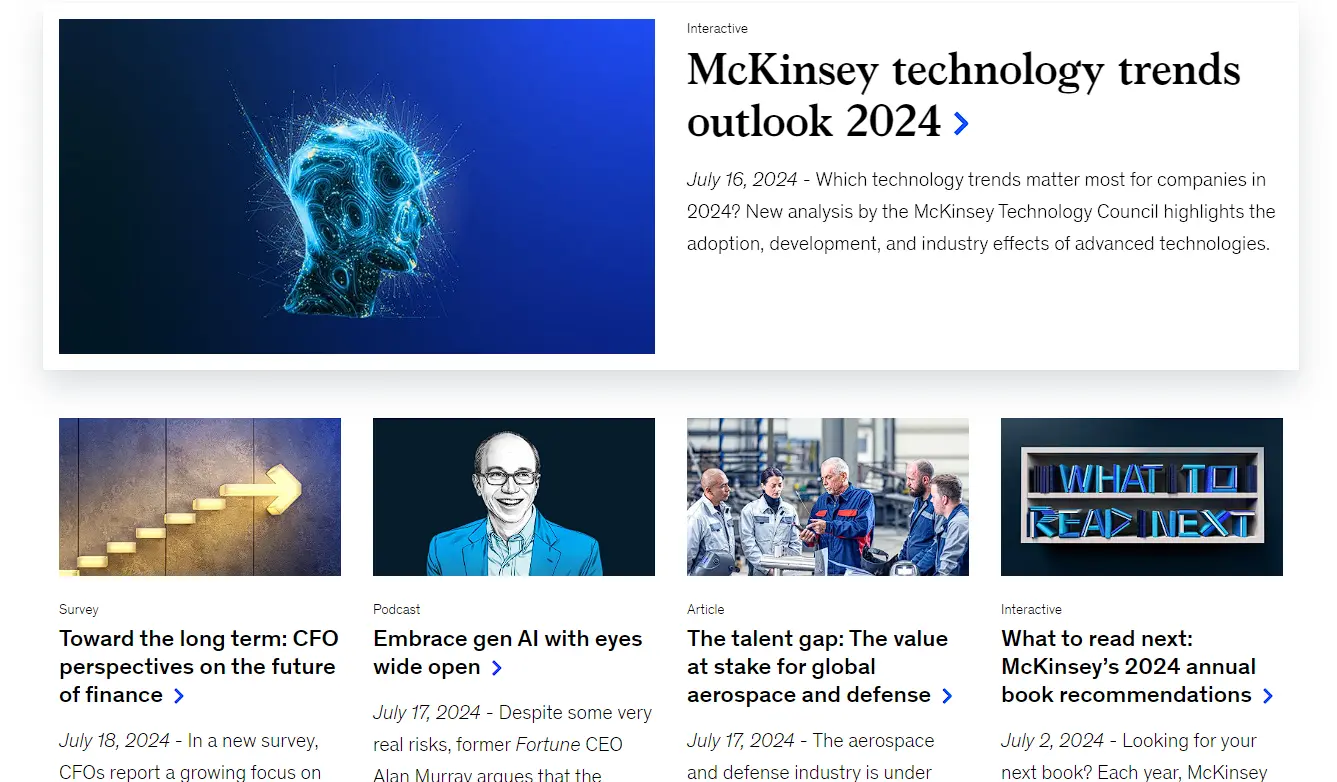
Image Source: McKinsey
One 2026 wrinkle worth building into this: short, sharply-argued POV pieces (600–1,000 words) on a specific industry inflection point tend to perform especially well for AI search visibility, because they answer specific, high-intent questions rather than summarizing trends everyone already knows. Publish these consistently, attribute them to named partners or practice leads, and link them back to your longer flagship reports.
The consulting firm has hundreds of forward-thinking original pieces and expert opinions across different topics that can convince people to work with them.
2. Case studies
You've had great testimonials from clients since you started consulting, right? That's a content treasure chest you're sitting on. You need to start showing those successful projects to people.
That's what case studies are about. You take potential customers on a voyage through the challenges other clients had in the past. Then, you show how the challenges were resolved, the step-by-step approach used, and the results.
It's like a detailed before-and-after story that provides social proof to prospects — just like this case study Ceros created for Allen Matkins, a leading law firm. It began with a description of the client and how the static content they created was ineffective at capturing people's attention, described how using Ceros switched things up, and rounded off with the results: Ceros helped capture and sustain visitors' attention longer than before.
In 2026, the highest-performing version of this format is interactive rather than a static two-pager: the client context and business problem in one navigable section, your methodology in another, measurable outcomes — with embedded charts — in a third. It's the same story, structured so a prospect can actually spend time with it instead of skimming it once.
3. Online workshops and webinars
Online webinars are simply seminars that are run over the web. You pick a topic for discussion, preferably an issue potential clients might be dealing with, and speak on it. You can even invite other experts to contribute.
Online webinars let you engage with participants in real time — they can ask questions, react to the discussion, and be more involved in the conversation. It's a good way to build personal connections, humanize your brand, and demonstrate expertise.
An example is this webinar from McKinsey, Future Frontiers: Navigating the next wave of tech innovations, where speakers discussed 15 top trends across categories like the AI revolution, building the digital future, and cutting-edge engineering — with the audience engaging live throughout.
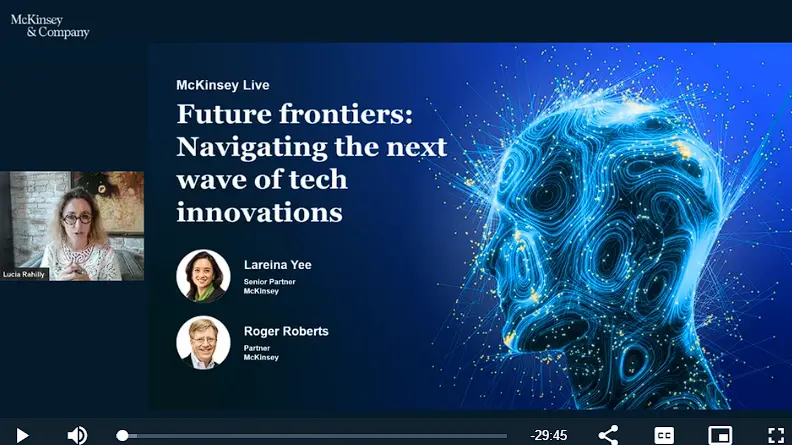
Image Source: McKinsey
Here, the speakers discussed 15 top trends that are the future of technology across different categories such as the AI revolution, building the digital future, cutting-edge engineering, and more.
And the audience engaged by asking questions about the topic.
4. Blog posts
Blogs are written content where you share insights with your target audience on relevant topics. You create content based on what people are searching for in your industry.
Let's say the audience is searching for what to look for in a consulting firm — you can create content that tells them what to look for. Content here can also be based on:
Pain points the audience is dealing with
Industry trends
Updates to your service offering
The goal of blog posts is to drive traffic to your site and, more importantly, educate your audience enough that they now trust you.
5. eBooks and white papers
This duo is widely referred to as gated content — content that requires people to provide some information about themselves (like an email and name) to access it.
eBooks and white papers are similar to blog posts but offer more comprehensive insights into topics. Here, you take the time to provide a detailed explanation of complex industry trends or challenges, touch on why people might experience such setbacks, and offer recommendations on how to solve them.
An example is this whitepaper from McKinsey in collaboration with China Chain Store and Franchise Association — a deep dive into China's retail market with solutions for executives navigating a business growth phase.
The PDF format still works here, but it's no longer the ceiling. Converting a flagship white paper into an interactive web experience — navigable by section, with embeddable charts — tends to get read more deeply and shared more often than the same content locked in a downloadable file. Flex AI can generate that interactive version from your existing PDF as a starting draft.

Image Source: McKinsey
It was a deep dive into China’s retail market and provided solutions to executives who needed to navigate their business growth phase by implementing digital strategies.
6. Infographics
We like to call infographics everyone's friend.
It's primarily a content type that lets you present complex data and insights in a visually appealing format that's easy to understand, using diagrams, charts, and images to break down the hard information. It also integrates well with other formats — a white paper can be hard to read, but adding infographics simplifies it. You can add them to case studies, blog posts, and more.
Because of its appealing, simple style, creating infographics increases the chances of people sharing the content.
7. Video content
Videos need no introduction — everyone loves this format. It's engaging, eye-catching, and captures and sustains people's attention. There are several ways to use video as a consulting firm:
Client testimonials, where existing clients share their experience with your firm.
Explainer videos, showing the audience how a concept or your service works.
Case studies in video format — an approach Ceros uses too.
Interviews with industry experts, like Jim Collins, author of
Built to Last
In Deloitte's case, videos bring the company's research to life. According to the financial services firm, videos illustrate its articles in greater depth — and scrolling through Deloitte's YouTube page, you'll also find inspirational stories tied to its global network.
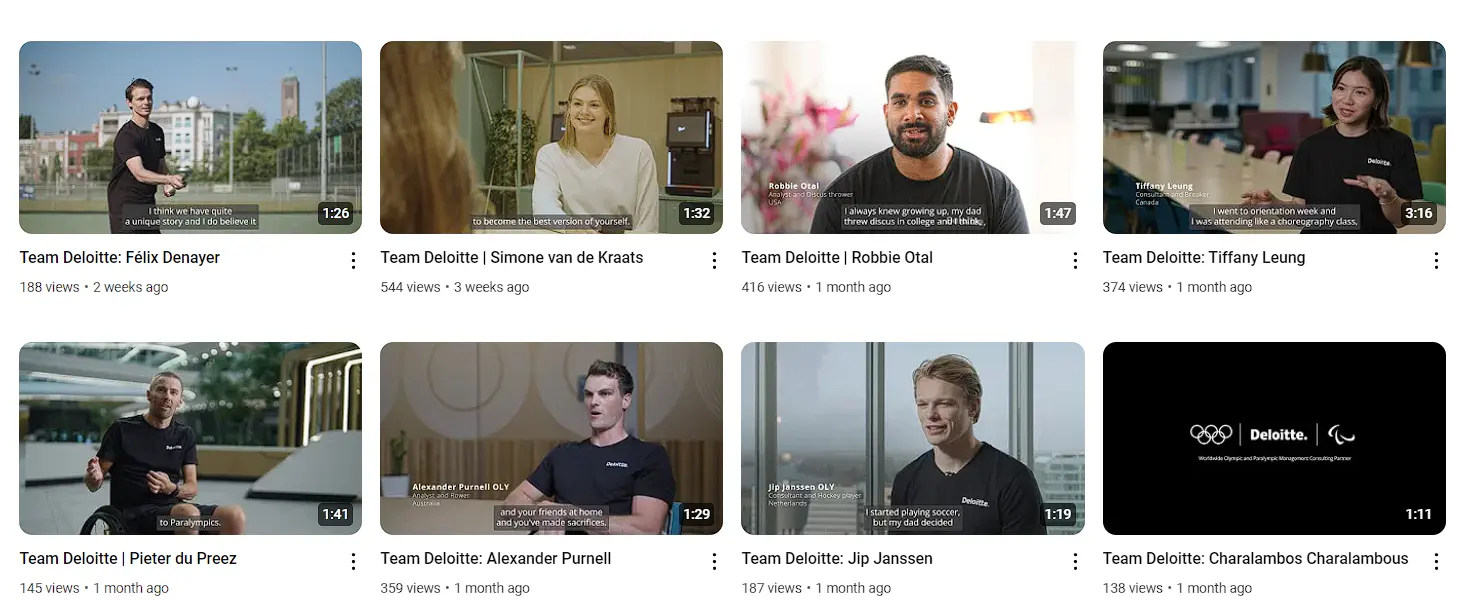
Image Source: YouTube
According to the financial services firm, videos illustrate its articles in greater depth.
And that’s precisely what you’ll find if you scroll through Deloitte’s YouTube page. It also has inspirational stories that are related to Deloitte’s global network.
8. Newsletters
These are personalized emails sent to existing and new clients to ensure you're at the front of their minds. It's also a good way to keep an open line of communication with them — daily, weekly, monthly, or quarterly, whatever cadence fits.
Think of this content format as if you're pen pals with prospective and existing clients. The newsletter can be about anything that adds value to them, such as:
Informing them about a report or survey you've just produced.
Curated industry news and what it means for them.
Updates about your firm.
Upcoming conferences or events that may be beneficial to your audience.
Recent success stories about how you helped a client a few weeks back.
Expert tips on how to tackle new policies that are being introduced.
Creating this type of content promotes client loyalty and could lead to repeat business.
9. Podcasts
This is an audio-based conversation for audiences that prefer listening to reading. You could invite industry experts to speak on trends, predict where they believe the industry is headed, or discuss best practices. Another option is to invite notable clients to discuss their journey — you can even repurpose webinars here so people can listen on the go.
That's what Deloitte did with its podcast series: different podcasts for different areas the firm is involved in, from tax to cloud computing to workplace well-being, reaching clients with varying interests. The format's biggest advantage is convenience — the audience can listen anywhere they choose.
10. Interactive content
If you want a content format that captures and glues the audience to their screen, interactive content is the right choice. It lets people actively engage with the content by playing a game, responding to a survey, or clicking and hovering over a hotspot to view information. It isn't just visually appealing — it gets the audience involved.
You can create a quiz that helps potential clients assess whether their business needs help, or a decision assessment that guides them through choosing the right services. If you'd like to see what this looks like, click here for our Inspire page, where you'll find examples and templates to try out. 😉
How can consulting firms create a content marketing strategy?
Simply by following the steps we’ve listed below. The first thing to do is…
Determine your goals
You need to define what you want to achieve for your consulting firm. No doubt an increase in sales is a good start, but you want to be more specific.
A better place to begin is to brainstorm with your teammates to highlight different areas that can help you achieve that objective — improving brand awareness or lead generation, for instance. You then want to refine it using our favorite S.M.A.R.T. framework:
Specific:
Clearly define what you want to accomplish.
Measurable:
Ensure you can track your progress.
Achievable:
Set a realistic target.
Relevant:
Make sure it aligns with your overall business objectives.
Time-bound:
Set a deadline for achieving the goal.
Here's what the goal would look like if you do: Increase brand awareness by 75% through launching targeted social media campaigns on LinkedIn and Twitter within Q4.
Define your target audience
Right after identifying what you're working toward, the next step is to determine your audience — this is important to know which approach to take when creating content so it resonates.
First, go through your social media following and check who engages with your posts the most: their titles, locations, company names, and how often they engage with you. Second, take a quick peek at your competitors using Semrush's One2Target tool — type in their URL and it loads the audience demographics you need. Third, interview existing repeat buyers about the challenges they face, their primary goals, what they love about your service, their preferred content type, and how they stay informed about industry trends.
Find the right topics
Here are different ways to do this:
Create content around the challenges existing clients are dealing with, based on your previous research.
Carry out keyword research to find terms people are searching for in your industry using
Ahrefs' Keywords Explorer. Type in a keyword for a general search and click related questions or matching terms to identify what the audience is looking for.
Use Answer The Public to find content ideas — type in a keyword people are searching for and it'll show questions and terms to build content around.
Once you have your topics, structure the resulting content so it can actually answer the question — a clear definition up top, a direct answer before the elaboration, an FAQ block where it fits. That's what gets your firm cited when a prospect asks an AI assistant the same question instead of typing it into Google.
Create content consistently
In content marketing, you're trying to use content to convince people to work with you. As such, you can't have a once-in-a-blue-moon vibe — you need to keep producing content consistently, whether that's once or twice a week, once a month, or bi-weekly.
One way to do that is to create a content calendar using CoSchedule, an app devoted to scheduling. Along with an editorial calendar, using platforms that help you produce interactive content consistently makes content creation easier. A tool like Ceros lets you create and scale interactive content effortlessly so you can stay consistent and keep the audience engaged.
Promote your content
Next up, you need to think about letting people know about this high-quality content you’ve produced.
Here’s how to do that:
Launch an email campaign: If there’s an email list you send newsletters to, now is a good time to let them know you’ve got new content for them.
Collaborate with influencers and industry leaders: This involves them sharing the content with their followers and tagging you in the post.
Consider using paid ads: Another option is to promote the content via popular newsletters, blogs, or even boost it on social media.
Leverage social media: You can share bits of the content via social media platforms with links to the original to draw people in. You also want to add popular hashtags in your industry and trending sounds to get the algorithm to work in your favor.
If you’ve diligently followed the steps outlined here, you’re sure to have an effective content marketing campaign.
But then, how do you know the goals you set are being met?
Find out in the section that follows.
What key metrics can measure content marketing success for consulting businesses?
To know if you’re hitting set marketing goals or are close at least, here are key performance indicators (KPIs) to track:
Click-through rates (CTR): This is how many people clicked on your content, divided by the number of people who saw it. CTR is used to measure the effectiveness of keywords used so you know which one works for future campaigns. You can use Google Analytics to measure this if your website is connected to it.
Conversion rates: The number of people who’ve performed a desired action like subscribing, signing up, etc. Google Analytics can help track this too via the Reports dashboard.
User engagement: How many people are liking, sharing, and commenting on your content? That’s user engagement. You can monitor this metric via your CMS if the content is a blog or website post and a social media analytics page if it’s a social post.
Website traffic and rankings: Traffic is finding out how many people are visiting your website or checking out your content. Rankings, on the other hand, mean knowing your position on the search engine results pages. Both metrics can be tracked using Google Analytics too.
Now to wrap up, let’s discuss helpful tools that can simplify your content marketing campaign.
What platforms should consulting firms use for digital marketing?
Here are some top platforms we’ve curated for you:
Ceros: Need a tool to streamline the content creation process? Ceros is precisely the tool you need. It’s a platform that allows you to produce interactive content from templates. Once you sign up, find a template that represents the kind of content you want, and edit.
Ahrefs: This tool is your partner for all kinds of search engine optimization (SEO) tasks from keyword research to content audit, researching content ideas, finding link-building opportunities, and more.
Sprout Social: An all-in-one social media management tool, Sprout Social can help streamline your social media marketing campaigns. It can automate tasks like responding to customers, publishing social posts, notifying you of mentions on social media, and driving brand growth with influencer marketing. Overall, it manages all your social media accounts in a centralized location so you’re not all over the place.
Mailchimp: You can use Mailchimp to launch email marketing campaigns. It can help create landing pages to collect leads, draft the newsletters, schedule when to send them out to your email lists, and monitor their performance.
That brings us to the end of this guide. Let’s wrap up!
Over to you!
We've shown you different tools that can help streamline your content marketing campaign. But there's one tool that's so good we have to mention it again: it's Ceros, our very own tool.
Aside from promoting our platform, Ceros is a tool that delivers the results you want. It helps produce interactive content that can turn people's attention to you, bring in leads, and ultimately achieve your business goals. That's what Frost & Sullivan experienced when they used Ceros — they got a 150% increase in visibility, a 20% increase in click-through rate, and more.
Your consulting firm can experience that too.
Schedule a demo with us today and let’s pick it up from there.
![10 types of B2B interactive content & how to create them [2026]](/_next/image/?url=https%3A%2F%2Fimages.ctfassets.net%2F9fispija9xqh%2F01mhJxlyefPFgvt1OLHQBp%2Fb7f0589e3f994f1af6805dc6afa9a779%2Fe96d7dd3-b4f5-4a99-a5d3-d58fb8355d47.webp&w=3840&q=75)