SEO and AEO for interactive content: what actually matters
Cut through iframe myths and AEO hype. Here's what's actually documented to affect whether interactive content gets crawled, ranked, and cited.
BY Lydia Burns
September 18th 2026 – 5 minutes
GUIDES & TOOLS
SEO and AEO for interactive content: what actually matters
If you're building interactive content, two questions probably nag at you: will it get crawled, and will it get cited in the AI answers now sitting above search results? Both are fair worries. The trouble is that most of what gets repeated about them (iframes are invisible to Google, chunk your content for AI) is wrong.
What is answer engine optimization (AEO)?
Answer engine optimization is the practice of structuring content so it's more easily understood, summarized, and cited by AI-generated search answers (Google's AI Overviews, ChatGPT search, Perplexity, and similar tools) in addition to ranking in traditional results. Google has said these systems mostly run on the same ranking infrastructure as standard search, so the fundamentals that already mattered (intent, originality, credible sourcing) carry more weight than any AI-specific trick.
Embedding method affects crawlability, but not the way you'd think
The common claim is that content inside an iframe is invisible to Google. It isn't. Googlebot renders JavaScript and iframes and can attribute that content to the host page by default. Google built the indexifembedded robots tag specifically because publishers wanted to opt out of that default, not because it wasn't happening.
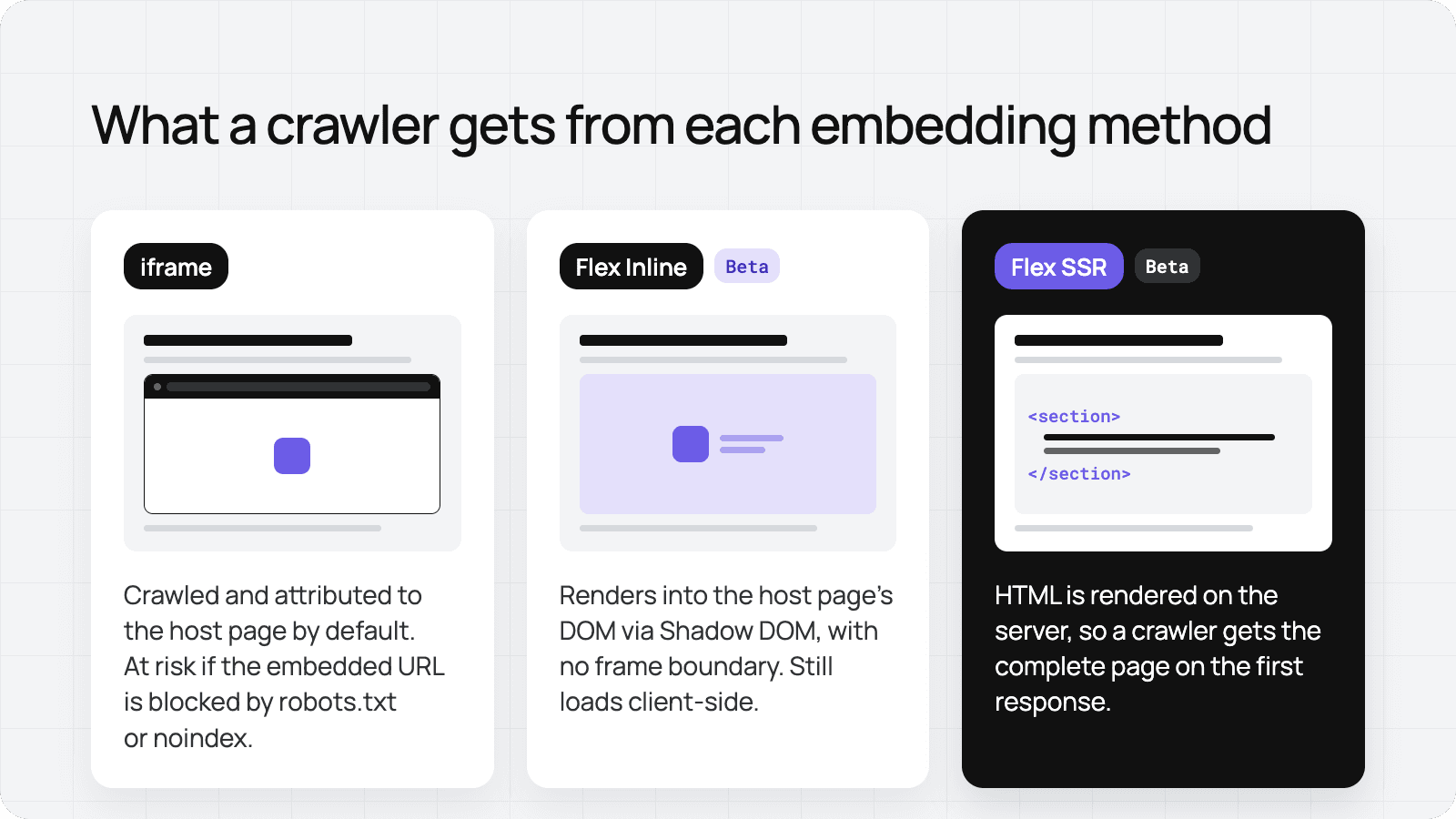
What actually breaks crawlability is narrower: if the embedded content's own URL is blocked by robots.txt or a noindex directive, the host page can't get credit for it. And separately, regardless of embedding method, Googlebot doesn't click, hover, or scroll the way a person does, so content that only renders after user interaction is genuinely at risk of being missed.
Flex offers two delivery methods worth being precise about here, since they solve different problems. Flex Inline renders a Flex experience directly into the host page's DOM (via Shadow DOM) instead of inside an iframe. It removes the frame boundary and gives a more native feel, but it still loads client-side. Flex SSR (server-side rendering) goes a step further: the server renders the experience's HTML before it reaches the browser, so a crawler gets complete HTML on the first response, with no dependency on JavaScript execution, interaction, or how a third-party domain's robots directives are set. Both are currently in beta, available through your CSM.
Most "AEO tactics" don't hold up: here's what does
Google's own AI-search guidance has directly debunked several tactics that get repeated as best practice: llms.txt files get no special treatment, "chunking" content for AI isn't necessary, AI-specific rewrites don't help, and there's no special schema markup for AI features. What Google has confirmed instead: higher organic ranking position correlates with AI Overview inclusion, and content with specific citations, quotes, and data has shown a meaningful citation lift in independent research.
One common claim doesn't hold up either: a large-sample Ahrefs study of over 560,000 AI Overviews found essentially no correlation between word count and citation likelihood; more than half of cited pages were under 1,000 words. Longer isn't the lever. Specificity is.
There's no dedicated schema markup for interactive experiences
Marketers sometimes look for a schema type built for tools, calculators, or embedded widgets. It doesn't exist. The closest fit, SoftwareApplication, is documented for app-store-style listings (it expects a price and rating) and Google hasn't clarified whether it's meant for browser-based interactive content. In practice, most sites wrap the surrounding page in standard Article or WebPage schema and don't force a mismatched type onto the embed itself.
Worth knowing if older advice is still floating around your team: HowTo rich results have been restricted to a narrow set of authoritative sites since 2023, and Google fully deprecated FAQ rich results in 2026. Neither is a reason to skip that content: FAQs and how-to structure still help readers and AI summarization, just don't expect either to earn a special result in search anymore.
Page experience: what a heavy embed can cost you
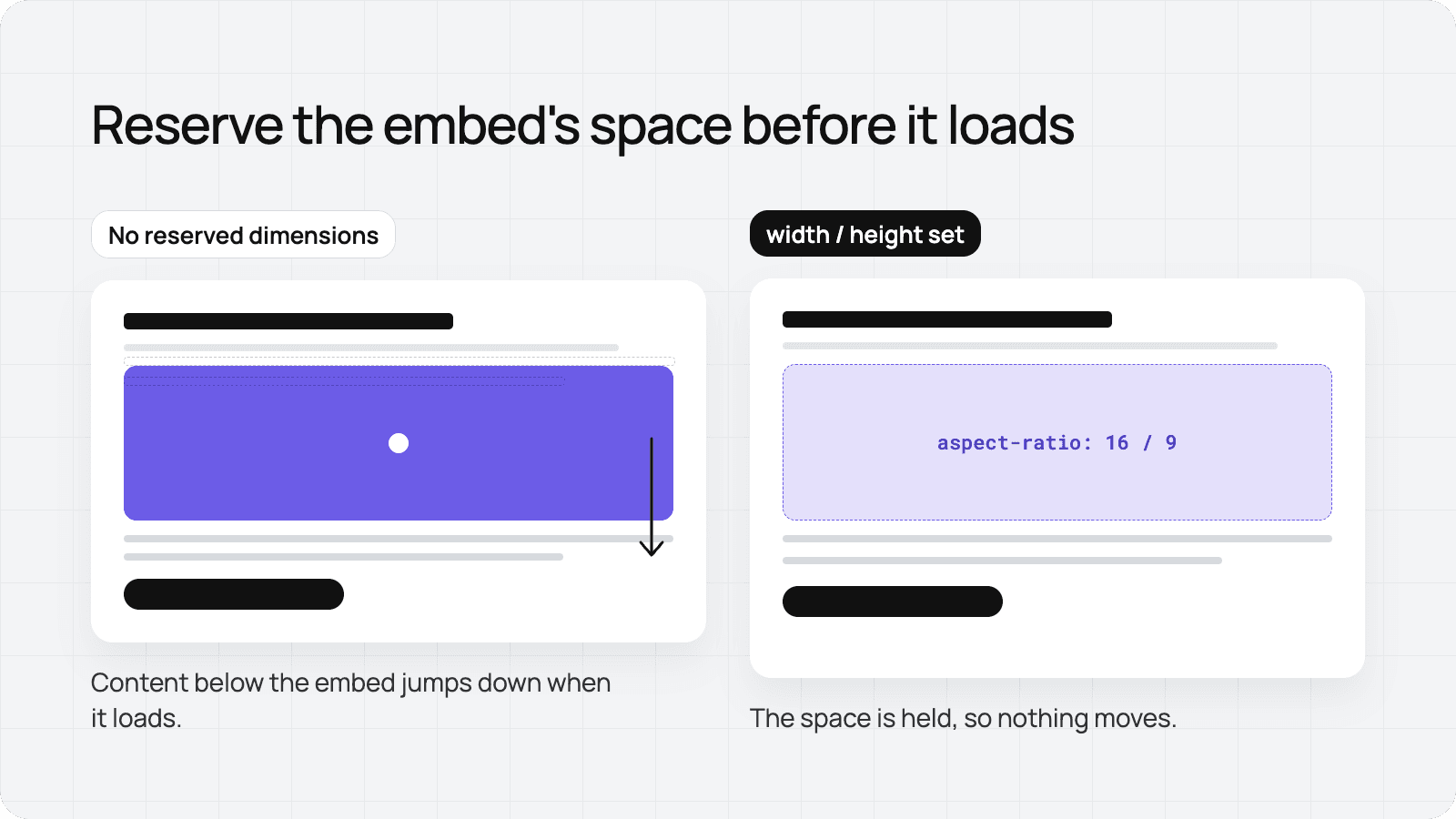
Interactive content tends to load more JavaScript than static content, and that has real, well-documented Core Web Vitals costs if it's not handled deliberately. An embed without reserved dimensions causes layout shift the moment it loads: set an explicit width/height or aspect-ratio to avoid it. A large embed loading immediately can delay your largest content from painting: lazy-load anything below the fold, and never lazy-load the actual largest element on the page. Heavy client-side hydration can block interactivity: deferring non-critical scripts and trimming what loads up front helps keep the page responsive.
The part that actually carries the SEO and AEO weight
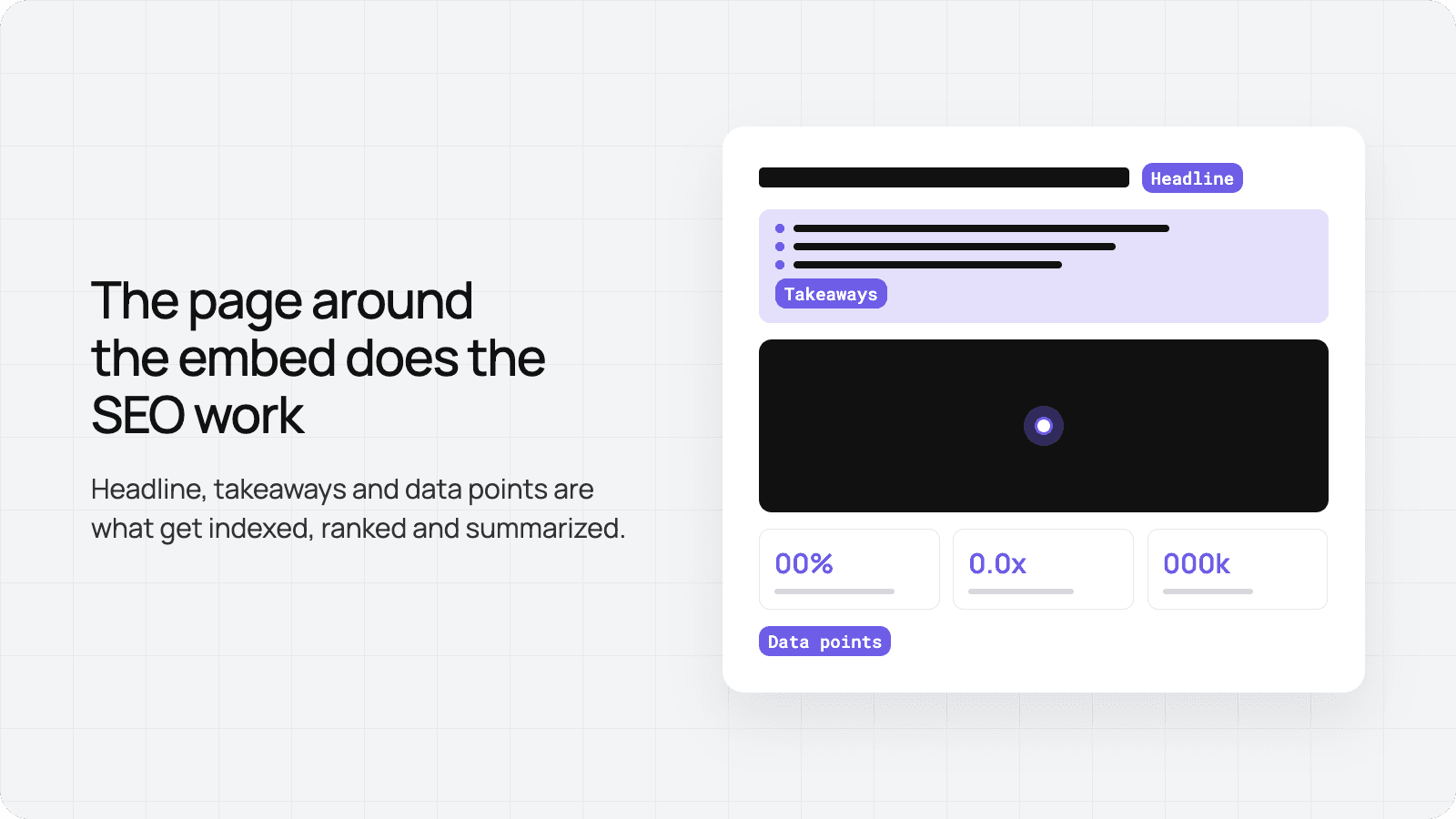
Google's AI answers are generated from the same ranking signals as regular search, which means the text surrounding an embed (the headline, the takeaways, the specific data points) is what actually gets indexed, ranked, and summarized. An interactive experience is worth building for the engagement and the story it tells, but the page around it is still doing the SEO and AEO work. If the same embedded experience appears verbatim across many pages with no unique surrounding content, that's a standard duplicate-content problem, not a Flex-specific one.
FAQs
FAQs for SEO and AEO for interactive content: what actually matters
See how Flex handles this for you
If you're weighing embedding method, page experience, or how your interactive content shows up in AI-generated answers, request a demo to see how Flex's delivery options (including SSR) handle it by default.