Still climbing: How Russell Investments built its 90th anniversary in Flex
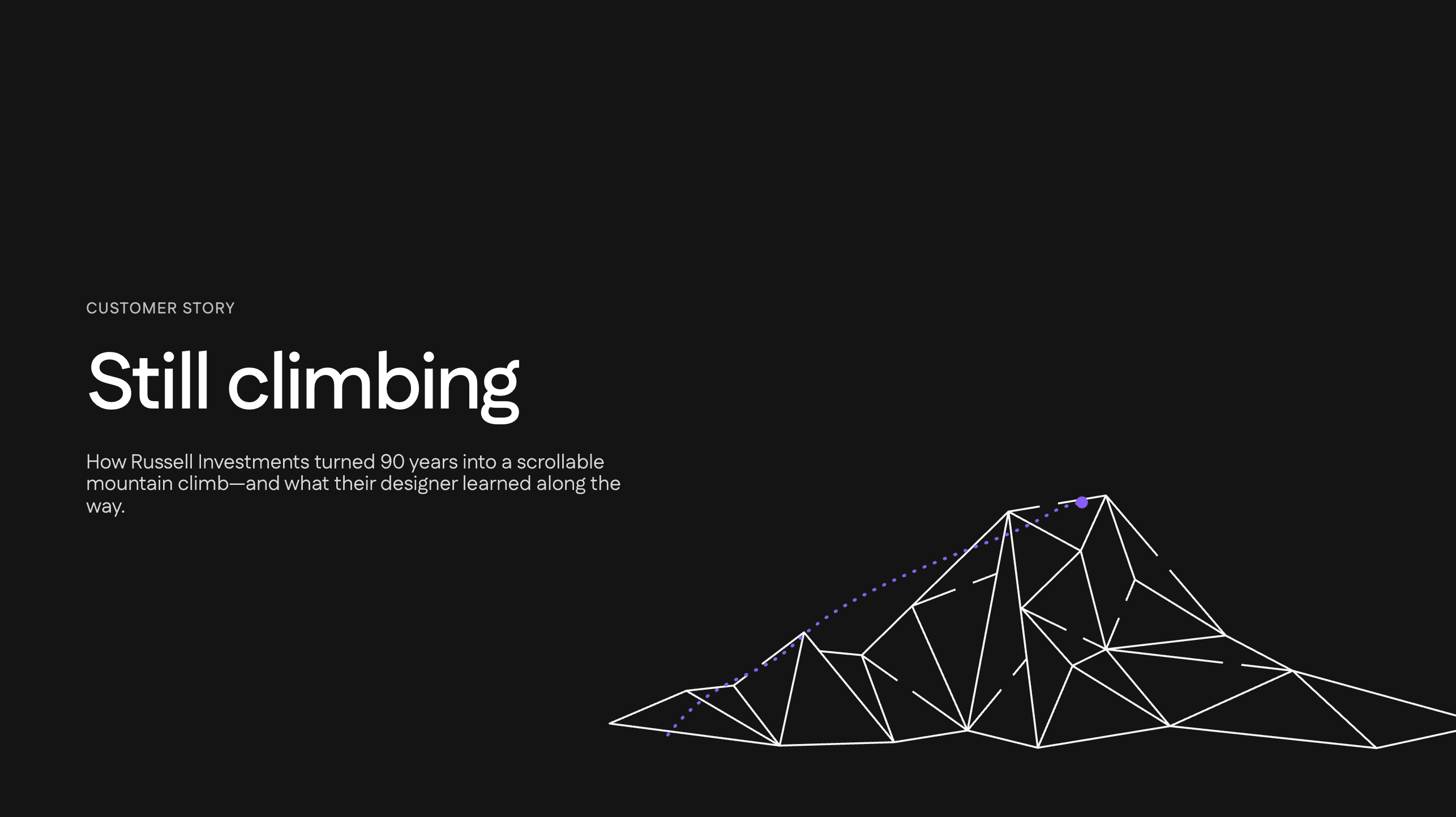
How Russell Investments turned 90 years into a scrollable mountain climb—and what their designer learned along the way.
BY Lydia Burns
August 5th 2026 – 5 minutes
CASE STUDIES
Still climbing: How Russell Investments built its 90th anniversary in Flex
For Russell Investments' 90th anniversary, Jared Simon and his team had a clear theme—90 years and still climbing—and a question: how do you tell a 90-year story without falling into a standard corporate timeline?
"We looked at a lot of different timelines," Simon says. "Most of them were really boring."
So the team started somewhere unusual: outside their industry. Russell's design agency had already proposed still climbing as the anniversary identity, building on something rooted deep in the company's history. George Russell, the founder, was a mountaineer. The mountain has been in the company's logo for decades. Russell has been taking team members up Mount Rainier for years.
"It's just always been part of our identity," Simon says.
The challenge was translating that identity into something digital that felt as deliberate as a print magazine and as alive as the first scroll of a feature film—without the constraints of Russell's enterprise CMS.
Choosing the canvas
Russell uses Adobe Experience Manager as their primary CMS. It does what an enterprise CMS does well, but it has its limits.
"There are a lot of benefits to it, but one of the downsides is that you can't really do a lot of custom, creative stuff," Simon says. "Which is why we use Ceros."
The timing helped. Ceros was rolling out Flex—the successor to Studio—and Russell was a beta user. Simon decided to use the anniversary experience as a real-world test of the new tool: a project ambitious enough to find Flex's edges, and visible enough to matter if it worked.
Learning Flex in real time
Simon hadn't worked in Flex before. The similarities with other creative tools helped.
"It's very much like Figma," he says. "That is helpful for designers, because it's familiar. It got me up the learning curve pretty far right away."
He learned by doing, building the experience and discovering capabilities as he went. A scroll-rotate animation on a newspaper article spread, for example, wasn't in the original concept.
"I wouldn't have had that idea, but I saw in scroll animations that you could do a rotate thing, and I was like, oh let's see what that does," he says. "Ideas came to life as we were building it, because we realized features were there that I hadn't even thought of before."
Some of the most-praised moments—the parallax clouds drifting at different speeds over the mountain, the logo rising like a sun behind the peak—emerged through iteration. The clouds, in particular, took work. ”It ended up looking really cool. The first scroll feels like the splash. Everything kind of moves, it comes alive," says Simon.
From timeline to story
The biggest creative shift happened internally. The concept had started as a timeline, but Simon and his team kept pushing toward something more editorial—"it started out as one thing in people's heads, and then it turned into a way cooler thing…just different," Simon says. "It started as a timeline, and then we went thematic with it instead. There are chapters that serve as story arcs. The timeline is part of that, but it's not linear."
Brand alignment mattered. Simon worked closely with Russell's brand manager, Jim, and the design agency Rotator, who shaped concepts like the topographic mountain parallax and the orange accent color used to pop key moments. The output is unmistakably Russell, just told in a way the company hadn't told a story before.
How it landed
The reception was immediate.
"Everyone loved it right away," Simon says. The piece was shared internally before Russell's alumni event. The CEO sent a personal note. The executive committee picked it up. Then Ceros featured the experience at the Adobe Summit.
"One of our vendors [Ceros] is showcasing our 90th anniversary story, and everybody here internally is very excited about the 90th anniversary," Simon says. "The way we're telling this story is resonating outside of our walls."
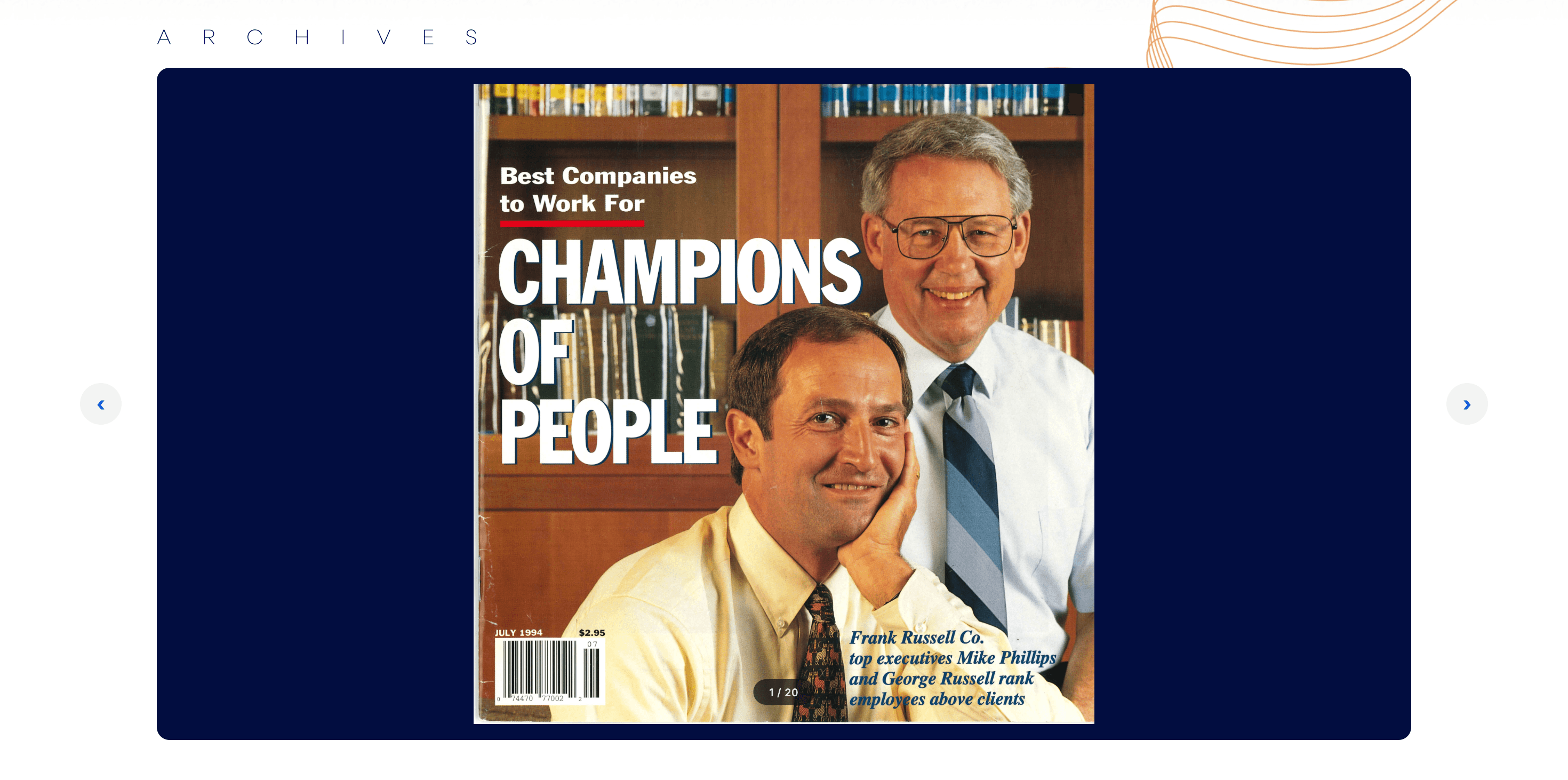
Dwell time on the experience averaged about five minutes—long enough to suggest readers were scrolling through and lingering on the photo carousels of archival images, old offices, and the original portraits of George and Jane Russell, the couple who started the company.
The bigger pattern
The 90th anniversary isn't the first time Simon has used Ceros to do what his enterprise CMS can't. His first Ceros project, years earlier, was the Cycle of Investor Emotions — a piece that earned a similar reaction from the team.
"Whenever I bring up, let's do that with Ceros internally, people think, oh, it's gonna be cool," Simon says.
He's quick to name what makes the difference.
"That's one thing that Ceros allows us to do—have pages feel different, not just look different," Simon says. "There's something about when you start to interact with a page—if it responds to you, it feels a little more alive, a little more responsive. Ceros makes that easy to do."