Interactive case studies: How to create engaging B2B examples

Discover interactive case study examples and learn how to transform static PDFs into engaging, high-converting customer stories that drive demand generation.
BY Lydia Burns
March 18th 2026 – 8 min read
GUIDES & TOOLS
Interactive case studies: How to create engaging B2B examples
This guide is for B2B marketers, content strategists, and sales enablement teams looking to create more engaging, high-converting case studies. Your buyer has done their research. They’ve read the G2 reviews, compared your pricing page against two competitors, and sat through a colleague’s recommendation. Now they want proof. Not a promise—proof. Case studies are a powerful way to prove your products or services work, showcase your expertise, and build trust with a potential customer who is evaluating your solution.
We cover what makes interactive case studies effective, provide ten actionable format examples, a step-by-step creation process, and performance metrics to help you measure success.
*__Quick definition:__ An interactive case study is a digital customer story built with clickable elements, animations, embedded data, and guided navigation—designed to move a reader through a narrative rather than ask them to extract one.*
A static PDF case study isn’t going to give them that. Not because the results aren’t real, but because a wall of text in a two-column layout doesn’t feel real. It feels like marketing. Consumers trust third-party reviews, testimonials, and data, making client case studies an effective form of social proof.
Interactive case studies do something different. They put the buyer inside the story—guiding them through the challenge, the decision, and the outcome in a way that feels less like reading a document and more like experiencing one. The numbers land differently when they animate in. The customer’s voice hits harder when it’s not buried in paragraph six. A case study documents the journey of working with your company and gives potential future customers a reason to trust your company.
What makes an interactive case study effective?
Not every piece of interactive content earns its complexity. The ones that do tend to share five characteristics. Here's what makes a good and effective case study.
Key characteristics of effective interactive case studies
A narrative built for one reader
The best case studies are almost uncomfortably specific. A CFO wants payback period and total cost of ownership. A VP of Marketing wants pipeline attribution and brand lift. Writing for both at once usually means writing for neither.
Interactive formats solve this without forcing a choice. Tabbed navigation, conditional content, and persona-based selectors let different stakeholders find what’s relevant to them—without making anyone wade through what isn’t. These interactive formats also allow you to assess customer needs, preferences, and the effectiveness of your case study content, enabling ongoing optimization.
Numbers that can’t be ignored
“Improved efficiency” isn’t a result. “Reduced content production time by 40% in the first 90 days” is a result. Before you open a design tool, identify your three strongest metrics. They’re not supporting details—they’re the architecture everything else hangs on. Case studies can showcase the results of a company's product or service through real-life examples and highlight measurable outcomes, such as increases in sales or customer engagement.
A before-state that earns the outcome
Readers don’t just want to see where your customer landed. They want to see where they started—and recognize themselves in it. Spending real time on the challenge, with honest detail, creates the emotional pull that makes the result feel earned rather than advertised. A well-structured case study typically includes a challenge, a solution, and the results achieved.
Before/after toggles and scrollytelling sequences are particularly good at this. They make the transformation visible, not just claimed.
Structure that respects how buyers actually read
B2B buyers scan before they commit. Your interactive case study needs to deliver value at three speeds: a headline stat for the five-second skim, a visual summary for the thirty-second pass, and the full narrative for the three-minute deep read. Build all three, explicitly. Most teams build only the third.
Conversion funnels that feel like a natural next step
Static case studies end with “Learn more.” Interactive ones can do better. A demo request that appears after the ROI section, when intent is highest. A template download after the methodology. A related customer story surfaced once they’ve finished.
The content isn’t the destination—it’s a step. Design it that way.
When implementing interactive case studies, it's important to outline your strategy, including the initial approach and any adjustments made throughout the process, to demonstrate effectiveness and results. Case studies can demonstrate the value proposition of your product by showcasing how it has benefited other companies. In addition to primary features, interactive case studies offer other benefits such as improved efficiency, cost savings, and positive environmental impact.
Worth knowing: Interactive experiences generate 2× the engagement of static content. That’s not a marginal lift—it’s the difference between content that gets read and content that gets closed.
Definition and purpose of interactive case studies
Interactive case studies are digital, simulation-based learning tools that place learners in real-world scenarios to solve complex problems. They function as digital, interactive stories where the learner acts as the decision-maker.
Interactive case studies are more than just digital versions of traditional case studies—they are in-depth investigations into a particular case or multiple cases, brought to life with digital tools and multimedia elements. By embedding real-world context and allowing users to explore at their own pace, interactive case studies provide a richer, more immersive experience than static documents ever could.
Purpose and scope
The primary purpose of interactive case studies is to deliver a comprehensive analysis of a business phenomenon, focusing on real-life context and naturalism. This approach enables marketers, researchers, and business leaders to dive deep into the details of a specific case, uncovering insights that are directly applicable to their own challenges. Whether you’re examining a single case or comparing multiple cases, the interactive format supports in-depth exploration and analysis, making it easier to connect findings to real-world business decisions.
By leveraging digital tools, interactive case studies transform business research into an engaging journey—one where users can interact with data, visuals, and narrative elements to gain a deeper understanding of the context and outcomes. This not only enhances engagement but also ensures that the analysis is grounded in the realities of the business world.
10 interactive marketing case study examples that convert
These aren’t abstract concepts—they’re distinct formats, each suited to a different audience, sales cycle, and story type.
1. The scrollytelling story
Best for: Long transformation narratives with a strong before/after arc
Why it works: The progressive reveal keeps attention without overwhelming. Readers feel guided, not lectured. This format can create a compelling case study that builds trust and showcases proof of product success.
2. The tabbed ROI deep-dive
Best for: Enterprise deals with multiple evaluators—Finance, Marketing, IT—each looking at the same purchase through a different lens
Why it works: It respects that different buyers care about different things, without making anyone sit through what doesn’t apply to them.
3. The data-led dashboard story
Best for: SaaS companies with strong quantitative outcomes and analytics-fluent buyers
Why it works: When data feels live rather than screenshotted from a slide deck, it reads as more credible. Numbers that move are numbers that land. This approach helps create a compelling case study that increases conversions through detailed storytelling and social proof.
4. The journey map case study
Best for: Consultancies, agencies, or platforms with a distinct implementation methodology
Why it works: It answers two questions at once: what did the customer get, and what would working with you actually look like?
5. The embedded video story
Best for: Brands with customers willing to go on camera
Why it works: Video is the most trusted form of B2B social proof. The designed context raises the production signal and keeps readers inside your content.
6. The comparison story
Best for: Competitive displacement plays where your buyer is actively evaluating a switch
Why it works: Buyers considering a switch need to see someone who was exactly where they are—and made it to the other side. This format is that story.
7. The use-case showcase
Best for: Platforms used across multiple industries or personas
Why it works: Personalization at scale. Instead of building ten case studies, you build one that speaks directly to each visitor. This format demonstrates how case studies can be used across various industries to illustrate best practices and successful strategies.
8. The micro-case study series
Best for: High-volume sales motions where buyers need quick proof across multiple funnel stages
Why it works: Breadth of proof matters. Twenty customer logos with outcome snapshots often outperforms one detailed story for buyers who are still pattern-matching.
9. The co-branded story
Best for: Partnership plays or enterprise customers who are also recognizable brands
Why it works: Double the distribution. Your customer’s marketing team promotes it to their audience. You promote it to yours. The asset works harder than anything either team would publish alone.
10. The “by the numbers” interactive infographic
Best for: ABM campaigns and executive audiences who want the headline fast
Why it works: Executives don’t have time for long narratives. A beautifully designed data story respects that—and still makes the outcome impossible to miss.
When designing for conversion, remember that an effective case study often includes a clear call to action to guide potential customers toward the next steps.
To maximize impact and build credibility, it’s important to maintain a dedicated resources page or blog section that includes case studies and customer stories.
These interactive case study formats can be used across various industries to illustrate best practices and successful strategies, making them a versatile tool in your marketing toolkit.
How to create an interactive case study (step-by-step)
No developer required. No six-week production cycle. Here’s the framework for content teams building at speed.
Step 1: Choose the right story
Not every customer win deserves the full treatment. Prioritize stories with:
A specific, measurable outcome—a percentage, a time saved, a revenue number
A customer willing to be named and quoted on record
A before-state that reflects a pain point your prospects will recognize
Relevance to a high-priority ICP segment or deal stage
Step 2: Run a proper discovery interview
The gap between a forgettable case study and a compelling one is almost always the source material. Go in with these questions:
What specifically were you trying to solve when you started evaluating options?
What had you already tried that didn’t work?
What metrics do you track, and what moved after implementation?
If a peer asked you why they should work with us, what would you say?
What surprised you most about the experience?
Including direct quotes from clients in your case study enhances credibility and provides valuable social proof.
Step 3: Lock the story arc before you touch a design tool
The most expensive mistake in case study production is designing around a narrative that isn’t finished. Write it out in plain text first:
Hook: the one-sentence version of the outcome
Context: describe who is the customer and what were they dealing with, providing detailed explanations of the challenges and processes involved.
The break point: what made the status quo unworkable?
The decision: why did they choose you?
The implementation: what actually happened, and how long did it take?
The results: specific numbers, with timeframe
The future: what’s next for the customer?
Step 4: Match the format to the content
Not every story needs scrollytelling. Use this as a quick reference:
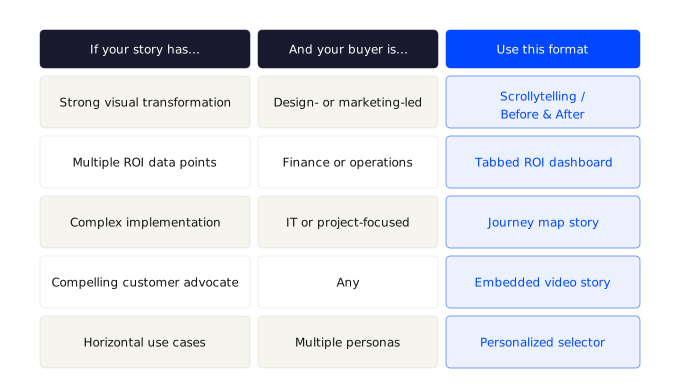
Interactive case studies bridge the gap between theoretical knowledge and practical application, providing a real-world experience and draw on ongoing interactive content creation insights and tips to stay effective over time.
Step 5: Build in Ceros Flex
Ceros Flex is built for exactly this kind of content. You can:
Start from a case study template and customize to your brand in minutes
Add animated stat callouts, tabs, scroll-triggered reveals, and embedded video—no code
Publish a URL that embeds directly in your CMS or loads as a standalone experience
Track scroll depth, time on section, and CTA clicks through native analytics or your existing stack
Use different methods for data collection and analysis to ensure your interactive case study is comprehensive and rigorous, and lean on Ceros Educate help center resources to deepen your skills as you go.
Step 6: Write copy in three layers
Your interactive case study needs to work at three reading speeds:
Headline layer: the key stat or outcome, visible immediately, in large type
Skim layer: pull quotes, subheadings, and callout boxes that tell the story in ninety seconds
Read layer: the full narrative for high-intent prospects who want the detail
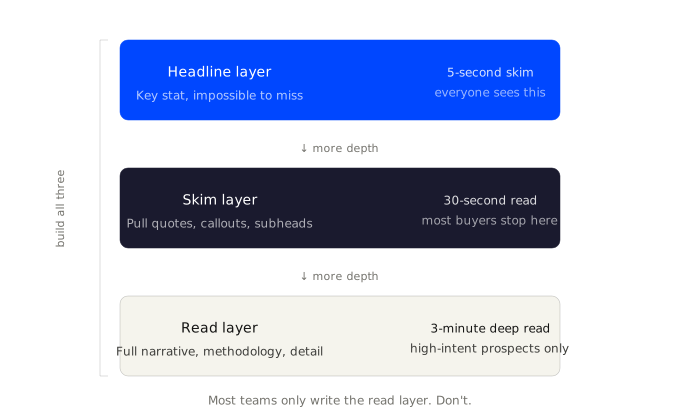
Write all three, explicitly. Most teams only write the third one and wonder why engagement drops off.
Step 7: Audit for conversion before you publish
Every interactive case study should have at least one clear next step embedded in the content:
Mid-content CTA: a demo request or consultation prompt after the results section—the highest-intent moment in the piece
Content upgrade: a downloadable version for ABM or sales enablement
Related content: two to three similar customer stories to extend time-on-site and build breadth of proof
Exit trigger: a soft re-engagement prompt for visitors who scroll back to the top without converting
Assess the effectiveness of your interactive case study and its development over time to ensure it continues to drive results and remains relevant.
Finding and using data for interactive case studies
The foundation of any compelling interactive case study is robust data. To create marketing case study examples that truly resonate, it’s essential to collect and analyze both quantitative data and qualitative data.
Types of data
Quantitative data: Metrics, percentages, and financial outcomes—provides the hard numbers that demonstrate impact.
Qualitative data: Offers the story behind those numbers, capturing insights from interviews, observations, and documents.
By combining these two types of data, you can conduct qualitative research that uncovers not just what happened, but why it happened. This dual approach allows you to present a more complete picture in your case studies, making your marketing case both credible and relatable.
For example, quantitative data might show a 30% increase in organic traffic after a campaign, while qualitative data reveals the strategic decisions and team dynamics that drove that success.
Collecting qualitative data—through customer interviews, feedback forms, or even newspaper articles—adds depth and context to your research. When you weave together these insights, your interactive case study becomes a powerful tool for both analysis and storytelling, helping potential customers see themselves in the narrative and understand the value your solution delivers.
Using storytelling techniques to boost engagement
Storytelling techniques are at the heart of the most engaging interactive case studies. By structuring your case study as a narrative—with a clear beginning, middle, and end—you transform dry facts into a compelling journey.
Storytelling elements
Characters: Your customer, their team, or even the product itself.
Plot: The challenge, the turning point, the resolution.
Multimedia elements like videos, images, and audio clips further enhance the narrative, making the experience immersive and memorable. These elements don’t just decorate the story—they bring it to life, allowing users to see, hear, and even interact with key moments.
This approach not only boosts engagement but also helps readers retain information, as they’re more likely to remember a story than a list of facts.
By combining a strong narrative structure with interactive and multimedia elements, your case studies become more than just evidence—they become experiences that inspire action and drive results.
Interactive case study templates & frameworks
Ceros Flex includes case study starting points you can customize to your brand. The case study approach is a research method involving an in-depth, detailed examination of a specific case or set of cases within a real-world context. Here are three structural frameworks worth knowing regardless of what you build in.
Types of case studies
Intrinsic case studies: Help researchers explore unique or outlier cases, often to understand deviant phenomena.
Instrumental case studies: Focus on an individual case to learn more about a broader issue.
Collective case studies: Also known as multiple case studies, involve analyzing several cases simultaneously to identify patterns or compare outcomes.
Case studies can highlight nearly any individual, group, organization, event, belief system, or action, making them a versatile tool for marketers and researchers alike, especially for enterprise teams using Ceros across industries.
Template A: The three-act story
Structure: Challenge → Solution → Results, with visual separation between acts and a data callout in each. This template is ideal for a single case study that requires an in-depth study, allowing you to present the entire case study in a comprehensive, narrative-driven format.
Works best for: Mid-market and enterprise deals with audiences who respond to narrative.
Key design principle: Each act should feel visually distinct. Background shifts or full-bleed section breaks signal the transition—don’t make readers guess where they are in the story.
Template B: The outcome-first case study
Structure: Lead with the headline result, then zoom out to context, then zoom in to methodology. This framework can be used for multiple case studies, enabling you to compare outcomes or analyze collective cases within the entire case study structure, mirroring how interactive content solutions by industry showcase patterns across different verticals.
Works best for: High-volume sales motions, web-native case studies, and ABM landing pages.
Key design principle: The most important number should be impossible to miss in the first ten seconds. Everything else earns its place by supporting it.
Template C: The multi-stakeholder evidence pack
Structure: Tabbed interface with dedicated sections for financial impact, operational impact, and strategic value. This template is also well-suited for multiple case studies, especially when you need to present collective evidence or compare different stakeholder perspectives within the entire case study.
Works best for: Enterprise accounts with committee-based buying and multiple approver personas.
Key design principle: Each tab should stand alone. A CFO who only reads the finance tab should have a complete, compelling story—not a fragment.
Case studies have commonly been seen as a fruitful way to come up with hypotheses and generate theories, adding research value beyond just storytelling.
In-depth analysis: what sets top interactive case studies apart
What distinguishes the best interactive case studies from the rest is their commitment to in-depth analysis and immersive engagement. Top-performing case studies don’t just present data—they offer a comprehensive, nuanced exploration of the case, using a blend of multimedia elements to make the story come alive.
Features of top interactive case studies
Videos, images, and audio to create an immersive experience
Interactive features like discussions, quizzes, and games to encourage deeper exploration and reinforce key findings
Optimized for performance, supporting strategies like google ads and organic traffic generation
Alignment with how Ceros pricing and plans scale for teams focused on ROI
By providing valuable, in-depth content that’s both engaging and easy to navigate, these case studies become powerful tools for both marketing and business analysis—helping you attract, educate, and convert your audience with depth and impact.
Measuring interactive case study performance and how to collect qualitative data
Static PDFs tell you one thing: downloaded. Interactive case studies tell you everything else. Measuring performance allows you to assess the effectiveness of your interactive case studies and adapt your approach for better outcomes. Here’s what to watch and what it means.
Engagement signals (is the content working?)
Scroll depth: What percentage of visitors reach the results section? Drop-off before that point usually means the hook or challenge section isn’t landing.
Time on page: Aim for 3–4× your static case study benchmark. If you’re not seeing the lift, your interactive elements may be decorative rather than functional.
Interaction rate: What percentage of visitors click at least one interactive element? Low rates suggest the design isn’t making interactivity obvious enough.
When measuring these signals, remember that a case study is an in-depth investigation of a person, group, or event used to understand behavior or identify patterns. It is also an in-depth examination of a particular case within a real-world context, so tracking these metrics helps you assess how well your content is achieving these goals.
Conversion signals (is the content driving pipeline?)
CTA click-through rate: Track mid-content and end-of-page CTAs separately. Mid-content CTAs near the results section typically convert 2–3× higher.
Downstream pipeline: Tag your case study URLs in your CRM so you can attribute deal influence, not just page views.
Sales enablement usage: Track how often SDRs and AEs share the URL in outreach. High-sharing rate = high sales team confidence in the asset.
Pro tip: Run a 60-day performance review on every new interactive case study. Compare scroll depth, time on page, and CTA conversion against your static baseline. The delta is your internal business case for scaling the format.
Common interactive case study mistakes to avoid
Most teams hit the same walls. Here’s how to avoid them.
Common mistakes
Designing before the story is locked
Most case studies fail when the story isn’t fully developed before design begins. Interactive design is expensive to re-sequence. Write the full narrative, get customer approval, then open your design tool. Discovering your story arc is wrong after you’ve built a scrollytelling experience costs 3× more time than getting it right in a document first. Building a compelling story helps participants connect emotionally with the material, and understanding the history of the case—its background and experiences—can clarify the causal mechanisms at play.
Treating interactivity as decoration
Animations and hover effects that don’t add information are noise, not engagement. Interactive case studies boost engagement, foster critical thinking, and improve retention by applying theory to practice. Every interactive element should do one of three things: reveal new information, let the reader self-select what’s relevant, or create a moment that makes a data point more memorable. Interactive scenarios pique interest more effectively than passive lectures due to their game-like nature. If it doesn’t do one of those, cut it. Actively investigating a scenario leads to deeper understanding and better memory retention. Immediate feedback models explain the nuance behind different decisions rather than categorizing them as simply right or wrong.
Writing for everyone, convincing no one
A case study written for a VP of Marketing will frustrate the CFO who needs payback period and total cost of ownership. Either focus tightly on one persona, or use tabbed or conditional content to serve multiple stakeholders without padding the experience for any of them. Defining clear objectives ensures every interactive element targets specific skills or knowledge areas.
No conversion path
The case study is not the destination. It’s a step. If it doesn’t have at least one clear next action—a demo request, a related story, a template download—you’re leaving pipeline on the table at the exact moment intent is highest.
Building for desktop only
More than half of B2B content is consumed on mobile, including content shared in sales outreach via LinkedIn and email. If your interactive case study isn’t responsive-first, you’re losing half your audience before they’ve read a word. Key methods for interactive case studies include integrating multimedia, using digital tools for collaboration, and implementing progressive disclosure, which allows information to be revealed in stages and facilitates iterative decision-making. Interactive whiteboards like Miro or Microsoft Whiteboard can be used for collaborative mind mapping and analysis.
Gating it
Don’t put a form in front of your case study. This is mid-to-late-funnel content—your buyer already knows who you are. Gating it signals distrust and creates friction at exactly the moment you want zero resistance. Give the case study freely. Use contextual CTAs inside it to earn the meeting. Anonymous submission platforms like Padlet encourage participation from quieter individuals by allowing them to submit ideas anonymously, and using a Think-Pair-Share approach encourages students to reflect individually before discussing in pairs and then sharing with the group. Establishing a safe space for open dialogue normalizes uncertainty and encourages sharing preliminary thoughts.
Turn your case studies interactive with Ceros
Your best customer stories deserve better than a two-column PDF that no one reads past page one.
Ceros Flex lets content and design teams build interactive case studies in hours, not weeks—no code, no developer bottlenecks, and no compromise on design quality. HTML-first output means your content is crawlable, accessible, and built for performance from the start. Start from a template, bring in your brand system, publish a URL that works everywhere.
See what your best customer story looks like as an experience people actually want to read.